The Tide Journal · Gulf Coast · October 5th, 2026
On the right night, in the right bay, the Gulf water glows.
Dinoflagellates — single-celled organisms that produce their own light through a chemical reaction involving luciferin and luciferase — bloom in the warm shallow water of the Gulf Coast bays in late summer. When they’re disturbed by a wave, a paddle, a swimming fish, they flash. A kayak moving through a bloom at night leaves a trail of blue-green light. The wake of a boat glows.
It is one of the more extraordinary things we’ve seen on this coast. And what makes it fascinating, beyond the obvious beauty, is what it is: a complex chemical reaction producing visible output, triggered by mechanical stimulus, occurring simultaneously across millions of individual organisms.
Complex chemistry. Coordinated output. Visible result.
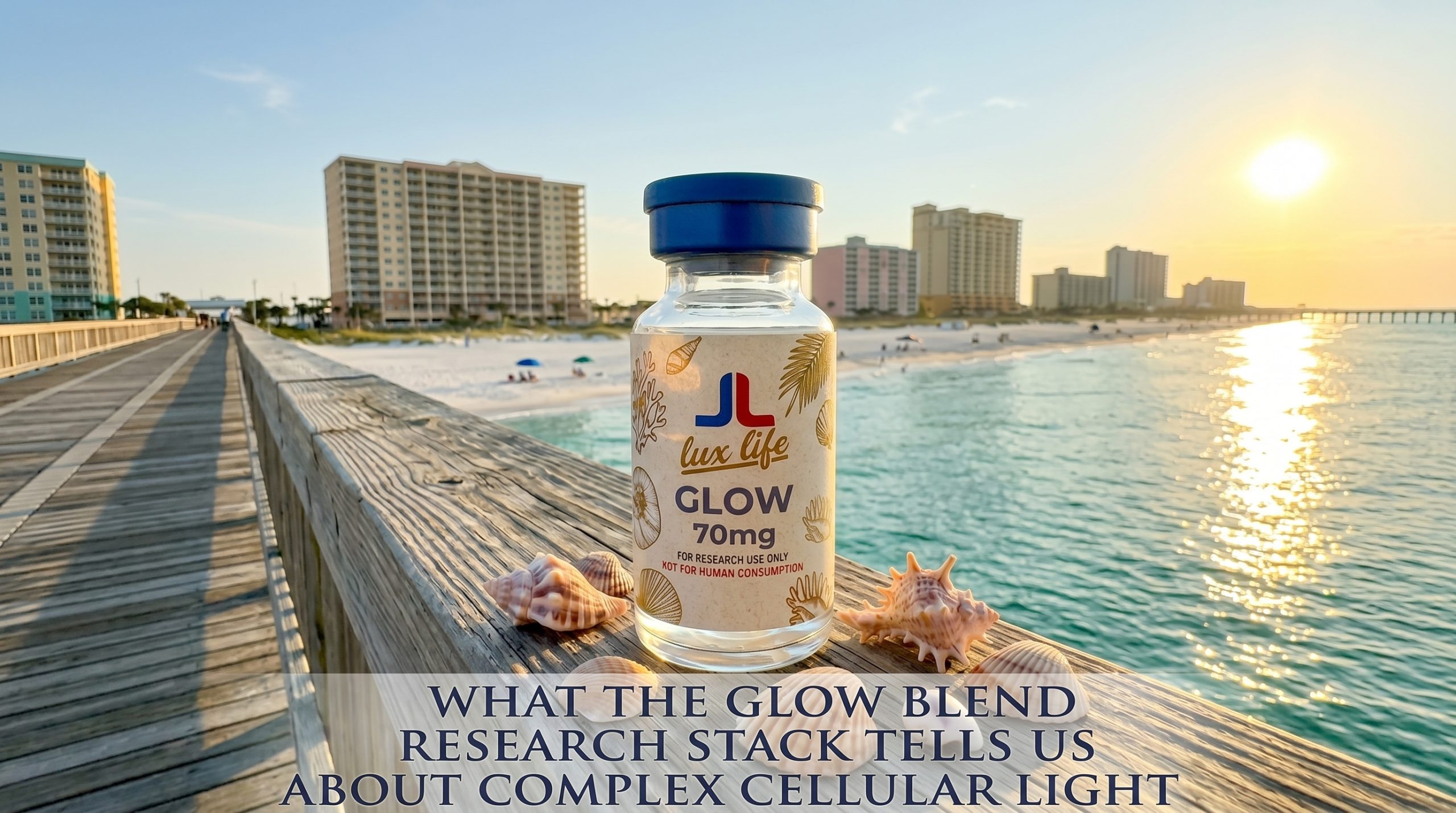
The GLOW blend is our name for a multi-compound research stack combining GHK-Cu (50mg), BPC-157 (10mg) and TB-500 (10mg) in a single 70mg lyophilized vial. It is designed for researchers studying the combined and interacting effects of multiple signaling molecules in a unified cellular environment.
What GLOW Is
The GLOW blend is a multi-compound research formulation containing GHK-Cu (copper peptide, 50mg), BPC-157 (10mg) and TB-500 (Thymosin Beta-4 fragment, 10mg). It is intended for in-vitro researchers who want to study the combined cellular effects of multiple signaling molecules simultaneously, rather than testing each compound in isolation.
Research using multi-compound stacks introduces complexity that single-compound studies cannot access — the interactions between pathways, the synergistic and antagonistic relationships between signals, the emergent cellular states that arise only when multiple inputs are active at once.
LuxLife Aminos GLOW 70mg is lyophilized, HPLC-tested at >99% purity, independently verified. Full COA at luxlifeaminos.com/coas.
Research References
- Pickart, L. & Margolina, A. (2018). Regenerative and Protective Actions of the GHK-Cu Peptide in the Light of the New Gene Data. International Journal of Molecular Sciences
- Sikiric, P. et al. (2016). Brain-Gut Axis and Pentadecapeptide BPC 157: Theoretical and Practical Implications. Current Neuropharmacology
- Goldstein, A.L. et al. (2012). Thymosin β4: A Multi-Functional Regenerative Peptide. Basic Properties and Clinical Applications. Expert Opinion on Biological Therapy
The Chemistry of Light
What the dinoflagellates do — coordinated bioluminescence — is not one reaction. It is many reactions, happening in sequence, in the right conditions, producing an output that none of them could produce individually.
That’s what multi-compound research is for. Not to test one signal. To test what happens when multiple signals are present at once, in the same cellular environment, at the same time.
The light only appears when conditions are right. The research only becomes interesting when the questions get complex enough.
Shop this compound · View every Certificate of Analysis · Research FAQ · Read next: Copper and Coast · Read next: The Resilient Coast
— Michael & Clarissa Wright
LuxLife Aminos · Gulf Coast, USA
All LuxLife Aminos products are intended strictly for in-vitro laboratory and research purposes only. Not for human or animal consumption. For Research Use Only. Terms of Service · Certificates of Analysis