The Tide Journal · Gulf Coast · October 5th, 2026
After a storm on the Gulf Coast, the beach looks destroyed.
Wrack lines of seagrass and debris mark the high water. Sandbars have shifted. The dunes have lost their grass. There are bare patches where sea oats once held everything together. To a visitor, it looks like damage that will take years to undo.
Come back two weeks later. The sea oats are regrowing from their root systems. The wrack line is breaking down into organic matter that feeds the dune. The sandbars have resettled into new equilibriums. The beach looks — not identical to before, but coherent. Purposeful. Repaired.
Coastal ecosystems have extraordinary capacity for repair precisely because they have been shaped by disruption for thousands of years. Repair isn’t an emergency response. It’s a baseline state.
GHK-Cu is a naturally occurring tripeptide — glycine-histidine-lysine bound to a copper ion — that has been studied extensively for its role in cellular signaling related to repair and remodeling processes. It is found in human plasma, saliva, and urine, and its concentrations in plasma decline with age.
What it signals — and to what — is what laboratory research is working to understand.
What GHK-Cu Is
GHK-Cu (copper peptide GHK) is a tripeptide complex consisting of the sequence glycyl-L-histidyl-L-lysine bound to a copper (II) ion. It was first isolated from human plasma albumin in 1973 and has since been the subject of extensive in-vitro research into its effects on gene expression, cellular proliferation, and extracellular matrix synthesis.
Research into GHK-Cu has explored its interactions with DNA repair mechanisms, antioxidant gene expression, and matrix metalloproteinase regulation in controlled cellular models. The copper ion is not merely a structural component — it is integral to the peptide’s biological activity, participating directly in the signaling cascade.
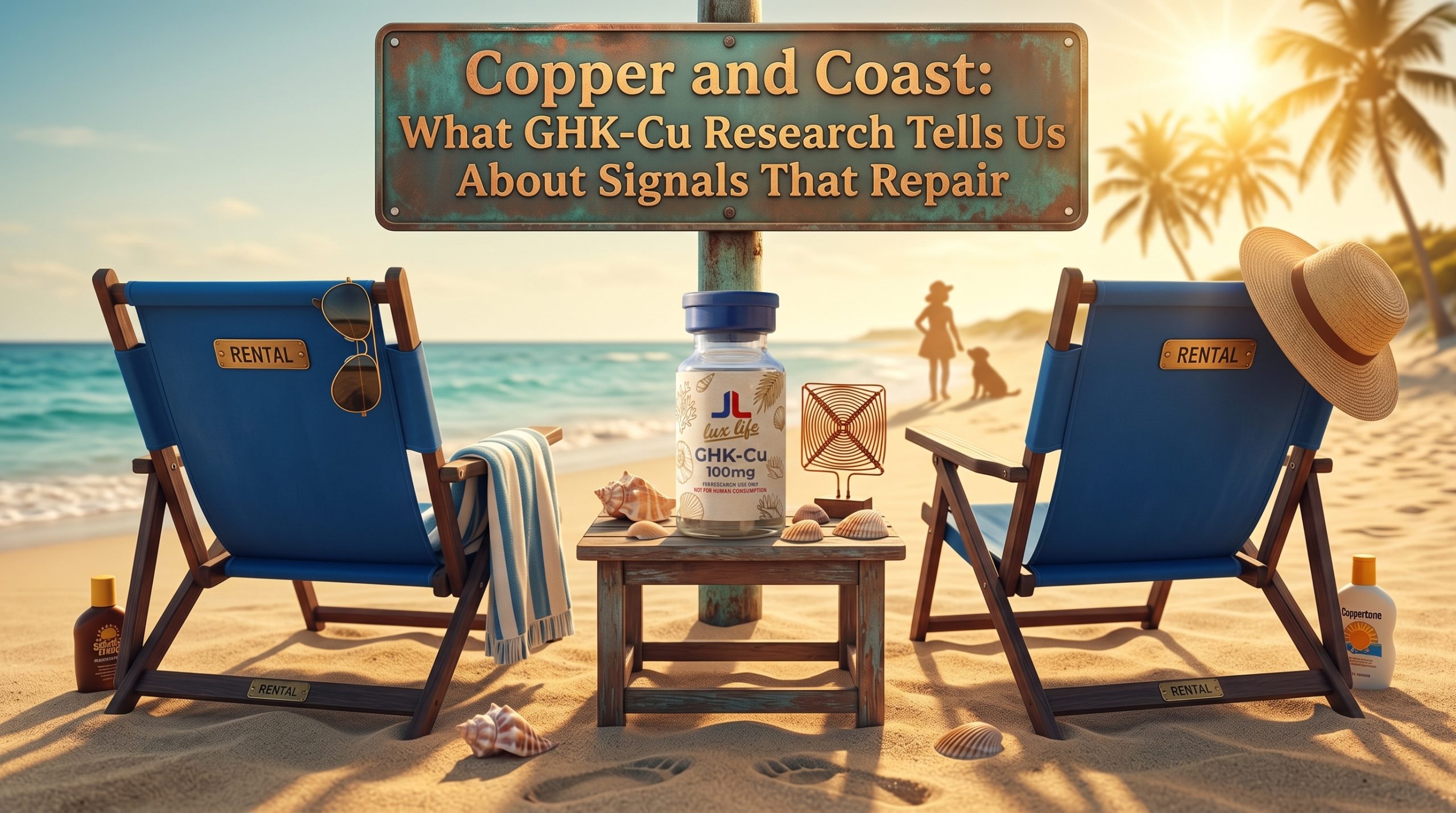
LuxLife Aminos GHK-Cu is available in 100mg vials, lyophilized, HPLC-tested at >99% purity. COA available at luxlifeaminos.com/coas.
Research References
- Pickart, L. & Thaler, M.M. (1973). Tripeptide in Human Serum Which Prolongs Survival of Normal Liver Cells and Stimulates Growth in Neoplastic Liver. Nature New Biology
- Pickart, L. et al. (2012). The Human Tripeptide GHK-Cu in Prevention of Oxidative Stress and Degenerative Conditions of Aging. Oxidative Medicine and Cellular Longevity
- Pickart, L. & Margolina, A. (2018). Regenerative and Protective Actions of the GHK-Cu Peptide in the Light of the New Gene Data. International Journal of Molecular Sciences
- National Library of Medicine. GHK-Cu (Copper Tripeptide) — PubChem Compound Summary. National Institutes of Health.
The Copper in the Coast
What we find beautiful about GHK-Cu as a research subject is how ancient the signal is. This tripeptide appears in human plasma at concentrations that decline measurably across a human lifetime. It is not a novel intervention — it is a molecule the body already produces, already uses, already regulates. The research question isn’t “does this exist?” It’s “what does it do, precisely, at the cellular level?”
That’s a different kind of question. And it requires the same kind of attention the coast requires after a storm: patience, precision, and a willingness to come back and observe over time.
Shop this compound · View every Certificate of Analysis · Research FAQ · Read next: Bioluminescence
— Michael & Clarissa Wright
LuxLife Aminos · Gulf Coast, USA
All LuxLife Aminos products are intended strictly for in-vitro laboratory and research purposes only. Not for human or animal consumption. For Research Use Only. Terms of Service · Certificates of Analysis