
The Tide Journal · Gulf Coast · October 5th, 2026
The longleaf pine ecosystem of coastal Alabama is one of the most fire-adapted environments on earth.
Before European settlement, the coastal plains burned every two to five years — lightning strikes in dry summers, fires spreading through the wiregrass understory. The longleaf pine evolved to survive this. The seedlings spend their first years as a grass-like tuft, putting all their energy into a deep root system rather than vertical growth. When the fire comes, the above-ground material burns. The root system survives. Within months, the seedling is growing again from a base that the fire couldn’t reach.
Two systems made this possible. The deep root architecture of the tree itself — its structural capacity to preserve and regenerate. And the wiregrass understory — which regulated the fire frequency and intensity, creating the predictable disturbance pattern the longleaf evolved alongside.
Two systems. One resilient outcome.
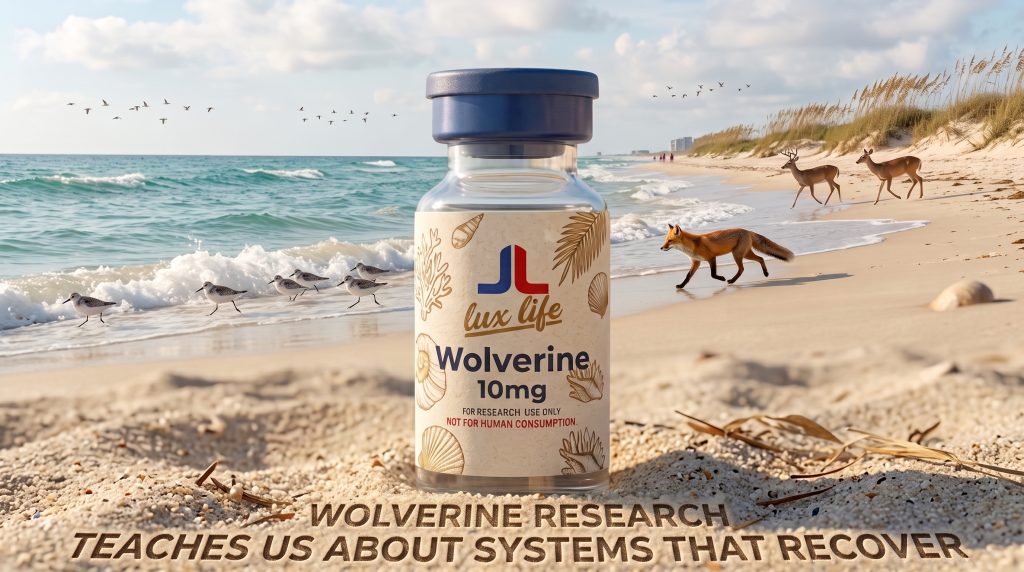
We named our BPC-157/TB-500 blend Wolverine because the research literature on these two peptides, in isolation and in combination, consistently returns to the same theme: cellular and tissue recovery mechanisms. BPC-157 and TB-500 work through different pathways. Together, in in-vitro and animal model research, they represent a dual-mechanism study platform for recovery-related cellular signaling.
What Wolverine Is
BPC-157 (Body Protection Compound 157) is a synthetic pentadecapeptide derived from a protein found in gastric juice. It is studied in laboratory and animal model research for its effects on angiogenesis, growth factor signaling, and the cellular mechanisms associated with tissue modeling.
TB-500 (Thymosin Beta-4 fragment) is a synthetic version of a peptide involved in actin polymerization and cell migration. Research into TB-500 has examined its role in cellular proliferation, vessel formation, and the regulatory mechanisms of the actin cytoskeleton.
The Wolverine blend combines both in a single lyophilized vial — 5mg BPC-157 and 5mg TB-500 — for researchers studying the combined and individual effects of both compounds in a single experimental system.
HPLC-tested at >99% purity. COA at luxlifeaminos.com/coas.
Research References
- Sikiric, P. et al. (2016). Brain-Gut Axis and Pentadecapeptide BPC 157: Theoretical and Practical Implications. Current Neuropharmacology
- Goldstein, A.L. et al. (2012). Thymosin β4: A Multi-Functional Regenerative Peptide. Basic Properties and Clinical Applications. Expert Opinion on Biological Therapy
- Vukojevic, J. et al. (2022). Pentadecapeptide BPC 157 and the Central Nervous System. Neural Regeneration Research
- National Library of Medicine. BPC-157 — PubChem Compound Summary. National Institutes of Health.
The Root System
What we find compelling about both BPC-157 and TB-500 as research subjects is their connection to foundational cellular processes — the kind that operate below the visible surface, in the root system, in the architecture that determines what a system can recover from.
The longleaf pine doesn’t wait for the fire to prepare for recovery. The preparation is built into the structure of the organism from the beginning.
That’s the kind of biology worth studying carefully.
Shop this compound · View every Certificate of Analysis · Research FAQ · Read next: Bioluminescence
— Michael & Clarissa Wright
LuxLife Aminos · Gulf Coast, USA
All LuxLife Aminos products are intended strictly for in-vitro laboratory and research purposes only. Not for human or animal consumption. For Research Use Only. Terms of Service · Certificates of Analysis