
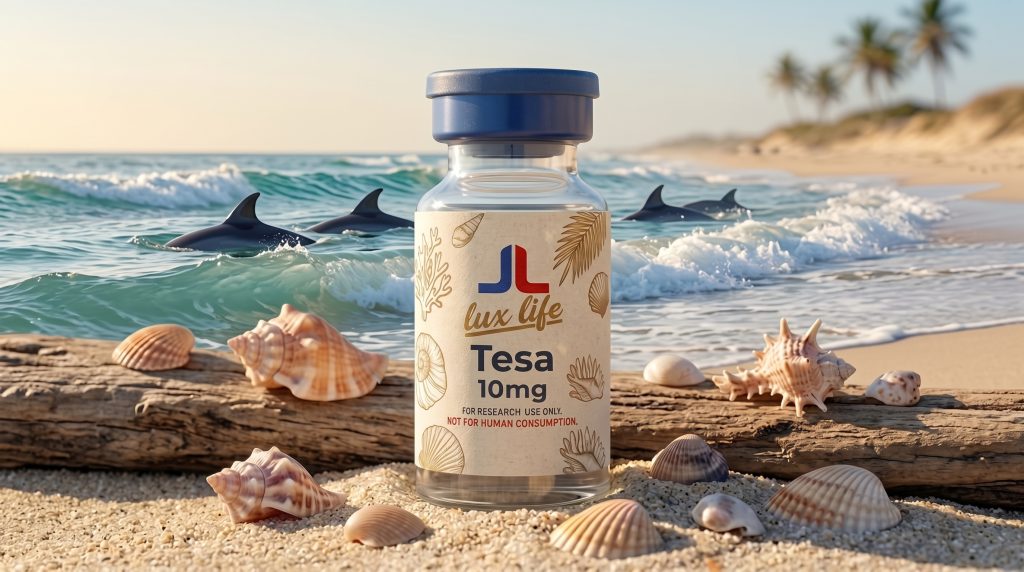
The Tide Journal · Gulf Coast · October 5th, 2026
The Gulf of Mexico doesn’t keep a flat shoreline. It breathes.
Twice a day, the water draws back — exposing sandbars, revealing shells, emptying the shallows — and twice a day it returns, filling everything back to the waterline as if the morning never happened. Clarissa noticed it on our first morning in Gulf Shores. We’d walked out to the water’s edge at sunrise and marked a shell in the wet sand. By the time we came back with coffee, the shell was gone. Not washed away — covered. The tide had come back in.
The ocean runs on a pulse.
Research into growth hormone-releasing hormone analogs begins with a similar observation: the body doesn’t secrete growth hormone in a flat line. It pulses. Short, rhythmic bursts — primarily during deep sleep, primarily in the early hours before dawn. The architecture of that pulse, its amplitude and frequency, is what researchers are studying when they work with synthetic GHRH analogs like Tesamorelin.
Understanding the rhythm, as it turns out, requires understanding what happens when it changes.
What Tesamorelin Is
Tesamorelin is a synthetic analog of growth hormone-releasing hormone (GHRH), a 44-amino-acid peptide produced in the hypothalamus. Like the endogenous version, Tesamorelin acts on pituitary somatotroph cells — the cells responsible for producing and releasing growth hormone. The synthetic analog has been modified at its N-terminus with a trans-3-hexenoic acid group, which increases its stability compared to native GHRH and extends its half-life in solution.
It is this structural modification that makes Tesamorelin particularly interesting for in-vitro research. Where native GHRH degrades rapidly, Tesamorelin maintains its binding affinity longer — allowing researchers to study GHRH receptor interactions, downstream signaling cascades, and the cellular effects of sustained versus pulsed stimulation in controlled laboratory conditions.
Our batch of Tesamorelin 10mg is lyophilized, HPLC-tested at >99% purity, and verified by an independent laboratory. The full Certificate of Analysis is publicly available at luxlifeaminos.com/coas.
Research References
- Falutz, J. et al. (2007). Metabolic Effects of a Growth Hormone-Releasing Factor in Patients with HIV. New England Journal of Medicine
- Clemmons, D.R. (2011). Consensus Statement on the Standardization and Evaluation of Growth Hormone and Insulin-Like Growth Factor Assays. Clinical Chemistry
- National Library of Medicine. Tesamorelin — PubChem Compound Summary. National Institutes of Health.
The Architecture of a Signal
When we think about precision in the laboratory, we tend to think about measurements — concentrations, volumes, temperatures, timing. But the most interesting precision in peptide research is structural. It’s the architecture of the molecule itself.
Tesamorelin’s N-terminal modification is a small change with significant consequences. That trans-3-hexenoic acid group shields the molecule from dipeptidyl peptidase IV (DPP-IV), the enzyme that would otherwise cleave and inactivate native GHRH within minutes. It’s a molecular bodyguard — not changing the signal, just protecting it long enough to be delivered.
That’s the kind of detail that fascinates us about this work. A single structural decision at the molecular level ripples forward into everything downstream. It’s the same principle as tide tables, as coffee marks on wet sand, as the patterns we keep finding in everything from the Gulf Coast to the laboratory bench.
The precision required at the beginning of a signal determines everything about what the signal can do.
Research Context
Studies investigating GHRH analogs have primarily focused on their effects on somatotroph function, IGF-1 secretion, and visceral adipose tissue regulation in controlled research models. Published literature has explored Tesamorelin’s interactions with the GHRH receptor, downstream cAMP signaling, and the pulsatile versus sustained release dynamics of growth hormone in cellular and animal model contexts.
For researchers working in these areas, the integrity of the starting compound is non-negotiable. A degraded analog produces degraded data. Which is why every vial we ship is lyophilized — removing water from the equation entirely and halting the hydrolytic degradation pathways that compromise peptide integrity in solution.
Store sealed at -20°C. Away from light and moisture. Reconstitute only what you need, when you need it.
From the Gulf Coast to Your Lab
There is a version of this business where we are a logistics operation — a warehouse, a shipping label, a tracking number. We made a decision early on not to be that.
We source every compound ourselves. We inspect every batch before it ships. We pack every order by hand, in our home, on the Gulf Coast of Alabama. And we put a seashell in every box — because we want the person opening it to know that two real people put it together with care.
The Tesamorelin in your order was handled the same way every compound we carry is handled. Which is to say: carefully. With the same attention we give to the tide tables, the shells on the shoreline, the rhythms that matter even when nobody is watching.
Shop this compound · View every Certificate of Analysis · Research FAQ
— Michael & Clarissa Wright
LuxLife Aminos · Gulf Coast, USA
All LuxLife Aminos products are intended strictly for in-vitro laboratory and research purposes only. Not for human or animal consumption. For Research Use Only. Terms of Service · Certificates of Analysis