
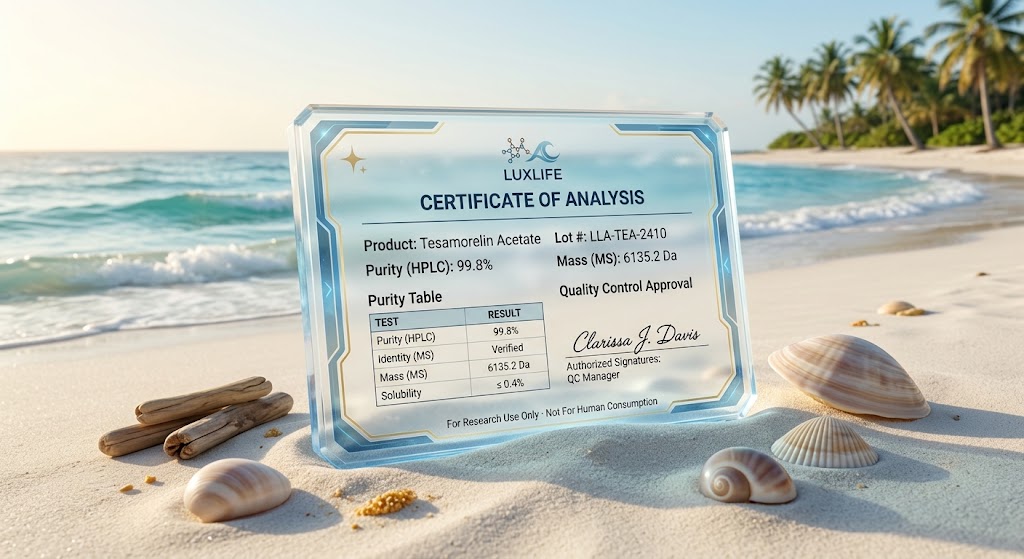
A Certificate of Analysis is the most honest document in this industry. It is also, for a lot of people, the most boring. We’d like to change that.
When we assay a batch, we run it against a reference standard on an HPLC — High-Performance Liquid Chromatography. The machine separates the contents of the vial by how strongly they interact with a stationary phase versus a mobile phase. What comes out is a chromatogram: a series of peaks over time.
The peak that matters is the one at the retention time of your reference standard. Its area, relative to the total area of all peaks, is your purity percentage. A number above 99% means that, by this method, almost everything in that vial is what the label says it is.
The questions worth asking before a vial reaches your bench:
1. Was it assayed against a reference standard, or only by area normalization? A reference standard is a known, traceable material. Area normalization is a self-referential estimate. Both have their place. Only one is a measurement.
2. What is the method? Reversed-phase HPLC is standard for peptides, but the column, mobile phase, and gradient all matter. A good CoA lists them.
3. Is the batch number on the vial the same as the batch number on the CoA? It should be. Always.
We publish our methods because we believe the work is more interesting when you can see it. If you’d like to see a CoA for a specific batch, write to us. We’ll send it.