
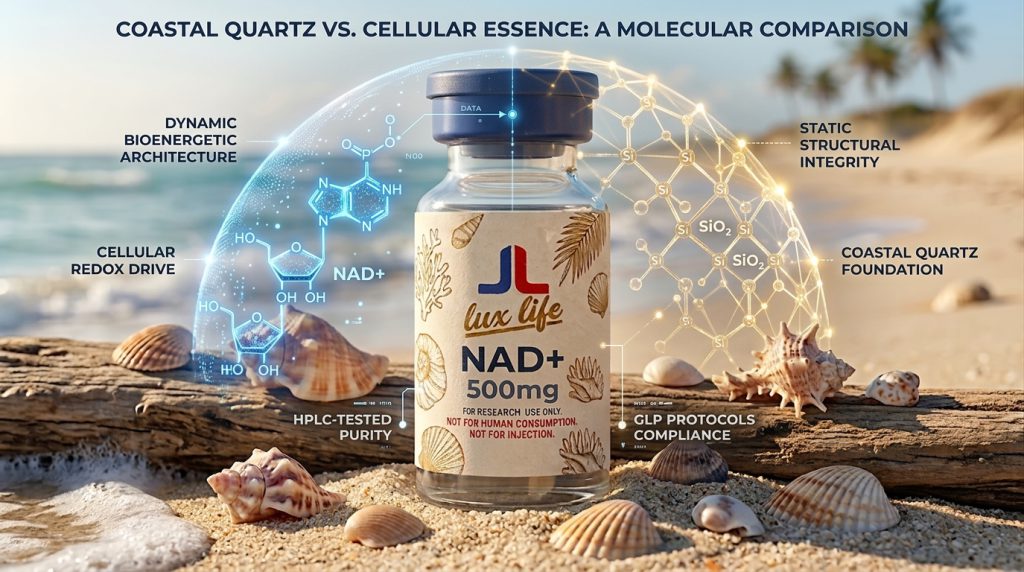
Walk along the iconic sugar-white beaches of Gulf Shores, Orange Beach, or Fort Morgan, Alabama, and you’ll feel millions of tiny quartz grains beneath your feet. Each individual grain of sand is composed almost entirely of silicon dioxide (SiO 2 ), a simple tetrahedral molecule that serves as the physical foundation of the Alabama coastline. In research laboratories across Alabama and nationwide, scientists evaluate a very different structural foundation:
Nicotinamide Adenine Dinucleotide (NAD+). While silicon dioxide builds the physical framework of coastal dunes, NAD+ provides the micro-foundational infrastructure for cellular bioenergetics.
At a molecular level, the silicon dioxide in Gulf Coast beach sand represents static structural stability. With a molecular weight of roughly 60.08 g/mol, it exists as a rigid, three-dimensional lattice where silicon forms covalent bonds with oxygen. It is chemically inert, non-reactive under standard laboratory conditions, and built to withstand the relentless movement of Gulf Coast tides without undergoing chemical change. In short, the sand molecule serves as an inorganic anchor defined by physical permanence.
In contrast, the NAD+ molecule embodies dynamic bioenergetic architecture. Weighing approximately 663.43 g/mol, NAD+ is a complex, water-soluble dinucleotide coenzyme featuring ribose rings, phosphate groups, an adenine nucleobase, and a nicotinamide functional group. Unlike static quartz, NAD+ functions as an essential electron carrier in biological redox reactions, rapidly converting to its reduced form (NADH) during metabolic processes like glycolysis and the Krebs cycle. In cellular research, it is actively evaluated for its key role in mitochondrial respiration, sirtuin activation, and PARP-mediated enzymatic signaling pathways.
Just as coastal dunes rely on high-purity quartz sand to maintain structural resilience against coastal erosion, molecular research requires uncompromising chemical purity to yield accurate, reproducible laboratory data. Operating out of Sulligent, Alabama in Lamar County, LuxLife Peptide Co. supplies academic and independent laboratories across the region with high-grade, HPLC-tested research compounds held to strict Good Laboratory Practice (GLP) protocols. Whether evaluating cellular electron transport mechanisms or metabolic pathways, consistent assay results depend on starting with fully verified compounds.
You can view the full analytical specifications and acquire our lab-verified LuxLife NAD+ Research Compound directly from our online catalog. Every shipment dispatched from our Alabama headquarters bridges high-level scientific compliance with our deep roots along the Gulf Coast, including an authentic hand-selected seashell collected along our coastal ocean travels with every order. Explore our full research catalog at LuxLifeAminos.com and save 10% on your initial laboratory order with code Coastal.
Disclaimer: For Research Use Only (RUO). Not for human consumption, medical diagnosis, or therapeutic use. All products sold by LuxLife LLC are strictly intended for laboratory analysis and scientific evaluation.